Showing posts with label Carrots. Show all posts

Saturday, January 16, 2016

Winter Veggie Tempura

I discovered a problem with my current cooking system.  Due to my working girl schedule these days, I no longer spend as much time looking through cookbooks as I once did.  I find myself making the same meals over and over--mostly just using this blog and my pinterest boards for menu planning.

Thus, I am back to adding some new recipes to the blog, in hopes of mixing up the menu planning a bit.

Of course, my cooking boyfriend, Yotam Ottolenghi's recipe for veggie tempura is my return to blogging recipe.  It's what's for supper tonight.

Winter Veggie Tempura
adapted a bit from Plenty by Yotam Ottolenghi

Dipping Sauce
6 cardamom pods
grated zest and juice of 4 limes (about 1/3 c lime juice)
1 fresh green chile (optional)
2 3/4 c cilantro, leaves and tender, thin stalks
1 T sugar
4 T sunflower oil
1/2 t salt
2 T water

Tempura
approximately 2 3/4 lb winter veggies:  our favorites are:

  1. leeks, white part sliced 1/4" thick
  2. sweet potatoes, peeled and sliced 1/4" thick
  3. broccoli, divided into medium florets (cauliflower would be good too)
  4. carrots, peeled and cut into 3/8" sticks
1/2 c cornstarch (plus possibly some extra)
1/2 c self rising flour (to make use 1/2 c regular plus a fat 1/2 t baking powder and small pinch of salt)
3/4 c seltzer or sparkling water
2 t grapeseed oil
3 C sunflower oil (for frying)

cooked udon noodles

To make the sauce, break the cardamom pods using the flat side of large, heavy knife.  Discard the pods and put the seeds in a food processor.  Add the remaining dipping sauce ingredients and blitz to get a smooth, runny sauce (you could also create the sauce using an immersion blender).

Mix the 1/2 c cornstarch, flour, seltzer, and grapeseed oil, along with 1/4 t salt in a bowl.  Whisk well to get a smooth runny mix.  On a dinner plate, sprinkle some additional cornstarch for coating the veggies.  

Pour the 3 c sunflower into a heavy saucepan or black skillet (I fry everything in my black skillet).  Place over high heat until oil is hot and then reduce heat to medium.    If you are unsure if the oil is hot enough, test the temperature using a candy thermometer.  The thermometer should register between 325-375 degrees.  

Toss each vegetable in the cornstarch.  Shake to remove any excess cornstarch and then dip into seltzer water batter.  Shake gently and then carefully ease the veggies into the oil (a few pieces of at a time--don't overcrowd the pan).  As the veggies fry, gently turn them over to fry evenly.  Leeks will take only about a minute.  Sweet potatoes would take 2 or more minutes.  Once they are cooked transfer to a paper-towel lined plate.

Serve on rice or over udon noodles (our favorite).  Steamed veggies on the side are also a good counter balance to the tempura veggies as well.


Friday, January 31, 2014

Lemongrass Beef Stew

In Austin, winter doesn't last long, so while it's here, I try to make the most of it.  We're a soup once a week or so type of family.  I embrace recipes that require long periods of time simmering on the stove or slowly cooking in the oven.

This recipe comes from my other Christmas present cookbook:  Vietnamese Home Cooking by Charles Phan.  I am so excited to cook out of this book, partly because I know I will learn some new cooking methods, some new ingredients, and some new recipes!

We loved this and our house smelled like loveliness for an entire day.  I started this in the morning, then set it aside and finished it later in the afternoon.

This serves 6 - 8.

Lemongrass Beef Stew
adapted briefly from Vietnamese Home Cooking by Charles Phan

3 lbs boneless beef ribs (I used chuck ribs, you could also use boneless short ribs or even boneless stew meat), cut into 1 1/2" cubes
4 T olive oil
1 t salt
1 large (about 2 c) onion, diced
3 cloves garlic, minced
1/4 c finely chopped lemongrass (cut in half, remove the thick out leaves and then finely chop)
3 T tomato paste
2 x 1" piece of ginger, peeled, then smashed or grated
2 whole star anise
6 c beef stock
4 carrots, peeled and cut into 2" lengths
8 oz daikon radish, peeled and cut into 1/2" lengths
2 T fish sauce
1/4 c basil (Thai preferable), finely sliced, for garnish (optional)
1 hot chile (a Thai chile or jalapeño is preferable), thinly sliced, if desired

Place the beef in a bowl.  Drizzle with 1 T olive and sprinkle with 1 t salt and 1/2 t black pepper.  Stir to coat and set aside.

In a large Dutch oven, heat 3 T remaining oil over high heat.  Working in batches, brown the beef on all sides.  Set browned beef aside.  In same pot, reduce the heat to medium and add the onions.  Cook, stirring frequently, until onion is a deep golden brown, stirring frequently.  Stir in the garlic and cook for another minute.  Add the lemongrass, tomato paste, ginger, and star anise and stir to combine.  Add the beef and any accumulated juices to the pot.  Pour the stock over top.  Bring to a boil, then decrease the heat so the stock is at a gentle simmer.  Cover and cook, stirring occasionally for 1 1/2 hours, or until the meat is just tender.  Add the carrots and daikon, cover again, and cook an additional 30 minutes or until the vegetables are cooked through and the meat is very tender.  Remove from heat and stir in fish sauce.

To serve, top with basil and sliced chiles if desired.

Thursday, December 12, 2013

Palestinian Meatball Soup

I went looking for this recipe thinking of an light Italian broth, tiny meatball, and vegetable type of soup.

This soup does not fit that description at all, what so ever.

This soup is a hearty, warm-your-healthy-bones soup (in other words, not a sick and I want to feel better soup).  This soup is the I spent an hour outside building a snow man with my kids and am freezing kind of soup.  Or, since here in our part of Texas we can't build many snowmen, it is the strong north wind, we're a bunch of wimps, it's 35 degrees out of type of soup.

This soup contains a spice mixture called baharat.  To make the baharat, you need a spice grinder (or mortal and pestle, which I can never figure out how to operate correctly).   The spices in baharat are pretty easy to find, especially if you can buy them bulk somewhere.  The recipe for baharat makes enough for three recipes of this meatball soup.  Make it all at once and set aside (in a tightly sealed container) and save it for next time.

The original recipe calls for freekeh, an ancient Middle Eastern grain.  The first time I made this recipe, I thought I had freekeh, but it turned out to be farro, so I used that instead.  The second time, I searched two stores (including Whole Foods) for freekeh and couldn't find it so I used the red wheat berries I had at home instead.  Both substitutions worked great.  Bulgur is also suggested by the original recipe authors.  Maybe one of these time I will visit a few more stores to attempt to find freekeh.  For now, I am happy with my substitutions, both of which were easy for me to find at Whole Foods.

We all like this soup, especially the meatballs.

This will serve 6 - 8 depending on the size of your eaters.

Palestinian Meatball Soup
adapted from Jerusalem by Yotam Ottolenghi and Sami Tamimi

Baharat Mixture:
1 t black peppercorns
1 t coriander seeds
1 small cinnamon stick, coarsely chopped
1/2 t whole cloves
1/2 t ground allspice
2 t cumin seeds
1 t cardamom pods
1/2 t whole nutmeg, grated

To make baharat:  place all the spices in a spice grinder and grind until a fine powder is formed.  It will keep for 8 weeks in an airtight container.

Meatballs
1 lb ground beef
1 sm onion, finely diced
2 T flat leaf parsley, finely chopped
1/2 t ground allspice
1/4 t ground cinnamon
3 T flour
2 T olive oil

Soup:
2 T olive oil
1 lg onion, chopped
3 cloves garlic, minced
2 carrots, peeled if desired and cut into 3/8"cubes
2 celery stalks, cut into 3/8" cubes
1 (14-oz) can diced tomatoes (with their juice)
2 T tomato paste
1 T baharat mixture (see above)
1 T ground coriander
1 cinnamon stick
1 T superfine sugar
1 c cracked freekeh, farro, or wheat berries (red or white)
2 c beef stock
2 c chicken stock
3 1/4 c hot water

chopped cilantro
lemon wedges

To make the meatballs, combine ground beef, onion, parsley, allspice, cinnamon, 1/4 t pepper, and 1/2 t salt.  Mix well with your hands and form into 24- 30 meatballs (or more or less depending on how big  you like your meatballs).  Heat the oil in a dutch oven or soup pot and fry the meatballs over medium heat until golden brown on all sides and cooked through.  Remove from pot and set aside.

In the same pot, add a little olive oil if the pot looks dry.  Add the onion and garlic and sauté for 5 minutes, scraping the browned meatball bits from the bottom of the pan.  Stir in the carrots and celery and cook for 2 minutes.  Add the diced tomatoes, tomato paste, baharat mixture, coriander, cinnamon stick, sugar, 2 t salt, 1/2 t pepper, and cook for another minute, stirring frequently.  Stir in the grain (freekeh, farro, wheat berries, etc) and cook for 2 - 3 minutes.  Add the beef and chicken stocks, hot water, and meatballs.  Bring to boil, cover, lower the heat, and simmer for 20 - 45 minutes (cooking time depends on the type of grain you are using), stirring occasionally, until the grain is tender.  Taste and adjust seasoning.

Serve sprinkled with chopped cilantro (don't skip this step.  This dish needs the cilantro) and with lemon wedges on the side (you can step this if you want).

Saturday, November 23, 2013

(Crock)Pot Roast

It's finally getting colder here for days at a time.  The soup and roast recipes are coming out, for nothing says warmth like the smell of meat roasting at home.

This recipe started out as an oven recipe.  I however, needed a crockpot recipe, so I adapted it.  I must admit, I overcooked it the first time, but the flavor was wonderful.  Next time, I'll be sure to time it to take it out when it's done and not leave it on warm for two or three hours than it should be.

(Crock)Pot Roast
adapted from The Pioneer Woman Cooks

1 (2 lb) chuck roast
2 T olive oil
2 onions, cut in half
6 - 8 carrots, cut into 2 inch slices
1 c red wine or beef stock
2 - 3 c beef stock
3 sprigs fresh thyme
3 sprigs fresh rosemary
2 lb potatoes, cut into chunks

Heat olive oil in a large pot or Dutch oven over medium-high heat.  Add the onion halves and brown them on both sides.  Put onions in the slow cooker.  Brown carrots in oil and transfer to the slow cooker.  If the pan looks dry, add a little more olive oil.  Sprinkle the roast generously with salt and pepper.  Brown the roast in the pot, turning until it is nicely browned on all sides.  Transfer to slow cooker.  Pour wine or 1 c beef stock into pot.  Stir, scraping the bottom with a spoon to release all the tasty browned bits.  Pour into slow cooker.

Add the potatoes and sprigs of thyme and rosemary to the slow cooker.  Pour in beef stock (start with 2 c, if meat looks dry during cooking, add the third cup).  Cook on high for 5 hours or on low for 8 - 10 hours.

To serve, meat from slow cooker.  Allow to rest for a bit (10 minutes will do) and then slice.  Serve on a platter with carrots and potatoes.

Wednesday, November 6, 2013

Banh xeo or Vietnamese Crepes

Plenty by Yotam Ottolenghi continues to please!


I decided this would be a good recipe based on the three daikon radishes that had been sitting in my crisper drawer for 6 months.  I figured it was time they were used, especially since we are due to get fresh daikon in box soon.

Let me start by telling you, I am not a crepe maker.  I've attempted it twice now, and well, both times things haven't gone well.  This time resembled the first time.  My crepes were too thick and sticking to the pan--they ended up as scrambled crepes instead of the real deal.  Thankfully, this time I had someone to bail me out.

As I stood, baffled, over the crepe pan, Curtis walked into the house in his biking clothes.  He had biked home from work and came over to see what I was doing.  "Your batter is too thick," he informed and then moved me out of the way and took over.  Whew.  In no time, he had the batter at the right consistency, heated up a second pan, and cranked up the heat on the first pan.  Before long, he was flipping crepes off the crepe pan (into the air--all fancy like) and pulling beautiful crepes off both the crepe pan and cast iron skillet.

That's one of the great things about being married.  Sometimes, when one of us is floundering, the other one call bail us out.

We learned a few things here:

•The pan temperature needs to be very hot.  The cast iron skillet works better than the crepe pan because it holds the heat better.

•The batter needs to be very thin.

•A single batch is probably plenty, but a double batch worked perfectly because there was a lot of room for trial and error.

•The electric griddle we use for making pancakes would probably work beautifully for this recipe.

Once we got the crepes off the pan in crepe shape, we served them straight the kids.  I was nervous we the filling wouldn't satisfy the kids or the taste of the crepes would throw them off.  Nope!  They loved the crepes.  J ate three and the other two each ate two.  The crepes tasted wonderful and the sauce was fabulous (the boys even ate the sauce.  M boycotts sauces on principal, unless we're talking maple syrup).

This recipes calls for enoki mushrooms.  I tried two stores (HEB and Whole Foods) and couldn't find them.  I finally found a cute bundle of them at our closest Asian grocery store.  I'd like to use them, but need to have the energy and time to go to multiple stores to source them.  If you want to add a meat, you can cooks some shrimp or prawns to add to the fillings.  HEB had the rice flour--which makes the recipe vegetarian (if you substitute sweet soy sauce for the fish sauce) and gluten free.

Serves 4 -5.

Bahn xeo or Vietnamese Crepes with Fresh Vegetables and Herbs
adapted a hair from Plenty by Yotam Ottolenghi

Crepes
1 1/3 c rice flour
1 egg
1/2 t salt
1 t ground turmeric
1 3/4 c (1-13.66 oz can) unsweetened coconut milk
a bit of sunflower oil

Sauce
2 1/2 T lime juice
1 1/2 T sesame oil
1 T brown sugar
1 T rice wine vinegar
1 T (or more, to taste) fish sauce (nuoc mam) or sweet soy sauce
2 t grated fresh ginger
1/2 t salt
1 garlic clove, crushed (optional)
1 fresh red chile, finely chopped (optional)

Filling
1- 2 large carrots, peeled and thinly shredded
1 daikon radish, peeled and thinly shredded
4 green onions, sliced on an angle
1 fresh green chile, cut into long thin strips
1 1/2 c snow peas (or more--we love these), cut into long thin strips
1/2 - 1 c cilantro leaves, roughly chopped
1/3-2/3 c basil leaves (preferably Thai basil), roughly chopped
1/4 c mint leaves, roughly chopped
1 c mung bean sprouts
1 c enoki mushrooms

Blend the rice flour, egg, salt, and turmeric in a large bowl.  Slowly whisk in the coconut milk, whisking well to avoid a lumpy batter.  Add more coconut milk or water (put water in the coconut milk can to get all the coconut milk out) until the batter is the consistency of light cream.  Set aside to rest.

Prepare the filling ingredients if you haven't already done so.  Put each filling in it's own bowl so people can choose what they want.

Whisk together all the sauce ingredients and adjust the flavor adding more red chile if using or fish sauce (if using).  Set aside.

To cook the crepes, add more coconut milk or water to the batter if it has thickened while resting.  Heat up a large nonstick frying pan (or a cast iron skillet or an electric griddle--the electric griddle doesn't let you swirl the crepe batter around though, which is kinda fun).  The pan should be pretty hot.  Add a little sunflower oil.  Put some batter in the pan, if not using an electric griddle, swirl it around to cover the surface.  Once the bottom is golden brown, carefully turn the crepe over.  If the crepe isn't cooked enough or the pan isn't hot enough, the crepe will probably stick and you'll end up with scrambled crepes.  Remove from pan and repeat with remaining batter.

Place a crepe on each plate and top desired fillings in the middle of it (like a taco!).  Drizzle some sauce over top and fold or roll up.  If desired, drizzle some extra sauce over top.


Friday, September 6, 2013

Shepherd's Pie

My library books are due tomorrow.  While that normally wouldn't make a difference to a recipe blog, if you have recipes from library books to modify, it makes a big difference.

While I have enjoyed the two recipes I made from Greenspan's Around My French Table, it's not one that is going on my "to buy" list.  Too fancy and time intensive.

This recipe started out in the fancy and time intensive way.  However, I strayed a great deal from the traditional French Hachis Parmentier (fancy pants French way of saying Shepherd's Pie).  I'm including a quick method and a slower method along with a couple of other changes I want to try next time I make this.

This serves 4 - 6.  If you want to make this ahead of time, do all but the potatoes.  Cook and mash the potatoes immediately before it goes in the oven.

Shepherd's Pie
adapted from Dorie Greenspan's Around my French Table

Slow Version Meat
1 lb boneless beef chuck, cut into 1" cubes
1 small onion, sliced
2 carrots, sliced 1/4" thick
1 stalk celery, sliced 1/4"thick
2 garlic cloves, smashed
2 parsley sprigs
1 bay leaf
1 t salt
1/4 t whole black peppercorns
6 c water

1/2 lb ground beef
1 t tomato paste
1-2  c mushrooms, sliced

Fast Version Meat
1 1/2 lbs ground beef
1 small onion, diced
2 carrots, cut in half and sliced 1/4" thick
1 stalk celery, diced
2 garlic cloves, minced
1 - 2 c mushrooms, sliced
1 t tomato paste
1- 3 c beef broth (you will use this as needed, amt will vary)
salt to taste
2 T parsley, chopped

The Topping (for both versions)
2 lbs potatoes, quartered (or cut into medium chunks)
1/2 c milk
1/4 c heavy cream (optional, can also just use an extra 1/4 c milk)
3 T butter, at room temperature
1/2 c Swiss type cheese (swiss, emmenthal, gruyere, comte, etc), shredded (optional)

For the slow version:
Put the beef chuck, onion, carrots, celery, cloves, parsley, bay leaf, salt, peppercorns, and water into a large soup pot and bring to a boil.  Skim off the foam that comes to the surface.  Lower the heat and simmer for 3 1/2 hours.  Strain the solids from the broth (meat and vegetables), reserving broth.  You won't use much of the broth, you reserve the extra broth for the next time you make the fast version of this.  Transfer the meat to a cutting board and chop into small pieces.  The meat will fall apart.  Set aside both the meat and the vegetables.

Put a large skillet over medium heat.  Brown the ground beef.  Add the mushrooms and cook until the mushrooms release their juices.  Stir in the tomato paste. Add the reserved vegetables and chopped beef.  Stir in a cup of the reserved broth and bring to boil.  You want the beef and vegetables to be moist, but not runny.  Season with salt and pepper.  Pour into a 2 qt oven casserole dish.  Set aside.

For the fast version:
In a large skillet over medium heat, brown the ground beef.  Add the onions, celery, and mushrooms and cook until the mushrooms release their juices and the onions have softened.  Add the garlic and saute another minute.  Stir in the carrots.  Add the tomato paste and 1 c beef broth.  Bring to a boil and simmer until the carrots are tender, adding more broth if the mixture gets dry.  Season with salt and pepper.  Stir in the parsley.  Pour into a 2 qt casserole dish.  Set aside.

For the topping (both versions):

While the ground beef browns, put the potatoes in a medium pot and add just enough water cover potatoes.  Bring the covered pot to a boil and simmer until potatoes are fork tender, about 20 minutes.  Drain well.  As soon as you are able, peel the potatoes (potatoes should still be very, very hot).  Heat up milk/cream.  Mash potatoes (I use an electric mixer to do this, you can do it however you prefer).  Pour in milk/cream, add butter, and continue to mash.  Season to taste with salt and pepper.  Scoop the mashed potatoes over the meat and vegetables, spreading them evenly throughout the pan. Sprinkle grated cheese over top if desired.  If you want, you can also dot the top with small pieces of butter (use a total of 1 T butter).

Bake at 400 degrees for 30 minutes or until filling is bubbly and the potatoes are golden. (If you don't use butter or cheese, the potatoes won't be quite as golden).

Tuesday, August 27, 2013

Vegetable Pot-au-Feu

One of my favorite cookbooks is Dorie Greenspan's Baking:  From My Home to Yours.  The recipes are rich, comfort food, gift worthy desserts.  I've worked my way through it, particularly the scones/muffins section and the cookies section.  I've attempted a few of her cakes with good results.  It's a book that has a permanently reserved space on my top-tier cookbook shelf.

A few years ago, Dorie (we're on a first name basis, you know?) came out with a new cookbook, Around my French Table.  I hemmed and hawed over whether or not I should buy it and I eventually decided against.  It just sounded too fancy.  I perused it at the bookstore and most of the recipes were heavy on meat, making it just a company cookbook (not an everyday cookbook, since we eat meatless at least half the week or more most weeks).  I finally realized I could check this book out of the library.

My expectations were more or less correct.  I found a handful of recipes I wanted to try, but not enough to warrant buying the book, at least not now.

This recipe is the exception.  In this vegetable pot-au-feu, vegetables have a starring role and it is a main dish (most of the vegetarian recipes in this cookbook are relegated to side dishes).  We loved it, M and Curtis especially.  I made poached eggs to serve in it, and learned for next time, the kids would rather go eggless.  That makes it even easier!

I made this in a wok, like Dorie suggested, but a dutch oven or soup pot would work just as well (and I'll probably use that next time).  Dorie also said this wasn't good leftovers--don't tell that to M!

This serves 4 - 6.

Vegetable Pot-au-Feu
adapted from Dorie Greenspan's Around my French Table.

2 T olive oil
2 garlic cloves, minced
1 small to medium onion, thinly sliced
1 leek, halved lengthwise and well rinsed, sliced
3 medium potatoes (6 small), sliced 1/4" thick
2 - 4 small to medium carrots, cut on the diagonal into 1/4" slices
3 c water (can also use vegetable or chicken stock)
1 2-inch piece lemongrass, split lengthwise
8 - 12 asparagus stalks, trimmed and cut into 1 1/2" pieces
4 - 6 shiitake mushrooms, stemmed and sliced
1/2 lb spinach, chard, or kale, stemmed, washed, and coarsely sliced
4 large eggs, hardboiled or poached
slices of crusty bread, toasted

Heat the olive oil over medium hat.  Add the onion and leek, season with salt and pepper, and sauté until they just begin to soften, about five minutes.  Toss in the garlic and cook for an additional minute. Stir in the potatoes and carrots, followed by the water and lemongrass.  Bring to boil, then reduce heat and simmer uncovered, until the vegetables are almost tender, about 10 minutes.  (While the vegetables are simmering, you can cook the eggs).  Add the asparagus and shiitake mushrooms to the vegetables and cook for an additional 4 minutes, or until tender.  Stir in the spinach (or other greens) and cook until  spinach (or greens) are slightly wilted.  Spinach will take about 2 minutes, chard slightly longer, and kale even longer.  Taste and season with salt and pepper.

To serve, place a slice of toasted crusty bread in a bowl.  Ladle soup over top and slice in the egg.  Serve immediately (I found it easiest to serve at the counter, not on the table).


Thursday, October 25, 2012

Warm Quinoa Salad with Grilled Chicken

I am in love with quinoa.  Seriously.  I love how it "pops" when it cooks.  I could easily eat a bowl of quinoa just seasoned with a bit of salt.

My husband doesn't share my emotions.  He can handle eating it, but is never thrilled by it.  He endures it. That all changed with this dish.  Maybe it was the fact I hadn't cooked for him in over a week (he worked late....I was out of town....), but he loved it.  Maybe it was due to the fact it was a hot day and he had biked home (yes, a hot day in October--very common here in Austin).  Regardless the reason, I was thrilled to find a quinoa recipe he loved.

We're not going to talk about the kids.  I need to serve quinoa a dozen or so more times before they'll agree to eat it.  It took them forever to start eating brown rice.  Patience is required with my three (in so, so many things).  They ate the grilled chicken eagerly and then Madeleine made them an alternate meal (so much easier to handle them not eating my cooking when I don't have to make the alternate).

I'll make this again, especially in the middle of winter when we are inundated with carrots.  This could easily be made vegetarian by just serving the salad without the chicken (which is how I am eating it for lunch today!).

Warm Quinoa Salad with Grilled Chicken
adapted just a little bit from Food and Wine

1 c quinoa (red, black or regular--I use regular because it's $3 a pound cheaper)
2 c water
1/4 c pine nuts
3 T olive oil
3 garlic cloves, minced
1/2 medium onion, chopped
2 medium carrots, halved lengthwise and cut into half moons (quarter lengthwise if they are fat)
2 t ground cumin
1 T balsamic vinegar (or 1 T plus 1 t sherry vinegar)
1 lb boneless, skinless chicken breast, cut into 1" cubes
2 T mint leaves, coarsely chopped

Put the quinoa in small saucepan and cover with water.  Add a generous pinch of salt and bring to a boil.  Reduce heat, cover, and simmer for 15 minutes or until water is absorbed and the quinoa is tender, about 15 minutes.

Meanwhile, toast the pine nuts in a large skillet over moderate heat until fragrant.  Watch carefully and stir often to prevent burning.  Remove from the skillet and set aside.  Heat the olive oil in a skillet.  Add the onions and the garlic and cook over medium heat until softened, about 5 minutes.  Add the carrots and cumin, cover and cook over low heat for about 5 minutes or until the carrots are just beginning to soften, about 5 minutes (you want them to still have a little crunch---not much, just not mushy carrots).  Stir in the quinoa and vinegar.  Season to taste with salt and pepper.

While the carrots are cooking, drizzle the chicken with olive oil and thread onto skewers (5 for us since there are 5 of us in our family).  Season with salt and pepper.  Grill over moderately high heat until the chicken is cooked through and browned, turning a time or two, about 5 - 10 minutes depending on how hot and even your grill is.

Garnish the quinoa and carrots with the pine nuts and mint.  To serve, take a good sized serving of the quinoa and carrots.  Top with the grilled chicken.

Monday, February 27, 2012

Ginger Scallion Fried Rice

I am branching out from my weekend of exceptional eating to pull in a recipe from earlier in the week.  This one will also be repeating itself frequently in menu rotation.

I remember eating a dish growing up called Vietnamese Fried Rice.  It was made using leftover rice, peas, and pretty much whatever else my mom could find in the fridge.  I had mixed feelings about it.  I think I once loved it, but as I got older, I appreciated it less.  I have never made that recipe myself, despite knowing exactly what cookbook it is in and what side of the page it is on.

Then I stumbled across this recipe.  The pictures promised me amazing things.  If I ate this recipe, it would invoke the setting and feelings represented in this magnificent picture.  Well, unfortunately I was not transported to snowy Yellowstone National Park Lodge in the middle of winter.  However, I did find a new recipe that I love.  It was a hit with everyone in the family and slight step up from the fried rice of my youth.

This is a good recipe to have everything mise en place (also known as prepped and ready to go before you start cooking).

Serves 4 - 5

Ginger Scallion Fried Rice
adapted from The Year in Food

4 T sesame oil
6 scallions, sliced, white and dark green parts kept separate
1 medium carrot, julienned or cut into matchsticks
1/2 c shelled, frozen edamame
3 T minced ginger
2 garlic cloves, minced
4 oz mushrooms, shiitakes are preferable, but white button mushrooms will do
2 medium eggs, beaten
3 c cold, cooked brown rice (white will do if you have no brown)
5 T tamari or soy sauce
1 c cooked, shredded chicken or tofu

Heat a large skillet over medium heat.  Add the 1 T of sesame oil.  Toss the white parts of the scallions and stir for about a minute.  Add the carrots, edamame, ginger and garlic and stir to combine.  Saute, stirring occasionally, for five minutes.  Remove from heat and set aside.

In the same pan, add another T of oil.  Add the mushrooms and saute until soft, stirring occasionally, about 5 minutes.  Remove and add to carrot/edamame mixture.  Increase the heat slightly, add another T of sesame oil and add the beaten eggs.  Cook as if you were making scrambled eggs.  When just cooked/scrambled, remove and add to carrot/edamame/mushroom mixture.  Add remaining 2 T of sesame oil and the cooked rice.  Spread rice evenly throughout pan and cook, stirring a little.  Sprinkle some black pepper over top.  After about five minutes (if rice seems to be sticking a lot to the pan, you can add some canola oil to the pan), add the tamari or soy sauce.  Stir to combine.  Add the bowl of cooked veggies and eggs and cooked chicken/tofu.  Saute, stirring frequently, until hot, about 5 minutes.  Remove from heat, sprinkle with dark green parts of scallions and serve.

Thursday, February 2, 2012

Vegetable Soup

Sometimes, only sometimes though, I am a bit of a slow learner.

M has been in school for 1 1/2 school years now.  I've packed countless lunches, the majority of them peanut butter and jelly sandwiches with a piece fruit, raw vegetables or edamame, a cheese stick, and a snack.  I haven't varied much from this, because M is happy with this lunch.  After a year and a half packing pb&j sandwiches for lunch, I've discovered an alternative--the thermos.

I can hear everyone sighing and saying, "Well, duh, Melani. Those have been around as long as sliced deli meat" (I am making this up, by the way, don't quote me!).  However, like I stated in the beginning, sometimes I am slow.

This vegetable soup has been one of M's favorite things to take her new thermos.  She's been asking for me to make it again, both for supper and leftovers for lunches.  Everyone else liked it too.

When I made this, I looked at the recipe and thought, another minestrone recipe just not labeled as minestrone.  I guess it's not though.  There is no pasta or cannellini beans.  It could easily be made vegetarian by omitting the pork listed in the beginning and using a well flavored vegetable stock in place of the chicken stock.  I actually didn't have potatoes when I made this, so I left them out and upped the amount of carrots I used.  I also threw in some celery for good measure.  Feel free to use the vegetables you have on hand.  I could see this being a good recipe to throw some kohlrabi in.

I found this recipe at The Year in Food.  There aren't a ton of posts, but when she does, the pictures are beautiful and the layout is uncluttered.  There are usually a lot of vegetables featured, sometimes strange grains (quinoa), and it follows the agrarian calendar.

This recipe will make 8 - 10 servings.

Vegetable Soup 
adapted slightly from The Year in Food

4 oz pancetta or bacon (optional--can substitute enough olive oil to saute onion in)
1 onion, diced
3 stalks celery, diced
6 c chicken or vegetable stock (or a mixture of either of those and water)
28 oz diced tomatoes (fire-roasted are especially tasty)
4 med potatoes, cubed (optional)
1 -2 sm/med kohlrabi, peeled and diced (optional)
1 bunch kale, stems removed and chopped
salt and pepper, to taste
red chile flakes, to garnish
Parmesan or cheddar cheese, to garnish

Heat a large soup pot over medium heat.  Add the bacon or pancetta and cook until the fat is rendered and it has browned (especially in the event you are using bacon, make sure it is good and cooked).  Remove excess fat (more than 1 T).    Add the onion and celery and cook until softened and onion is translucent.  Add the stock/water and diced tomatoes along with the potatoes (or kohlrabi).  Cover, reduce the heat to low, and simmer for 10 minutes, until the potatoes/kohlrabi are beginning to soften.  Add the carrots and continue to cook the root veggies are cooked, but still hold together well (don't cook to easily breakable stage).  Stir in the kale and cook just until kale has wilted and softened.  Taste and season with salt and pepper.

Serve hot.  Top with red chile flakes as desired and a grating of cheese.


Saturday, January 28, 2012

Asian Beef Stew

Once we discovered the wonder of the thermos we learned lunch options were endless.  This was another one of M's favorites to take for lunch, however, she did have to beware of the aromatics.

The star anise may be a little hard to source.  If you can buy it in bulk somewhere, it's very affordable and worth it.  The dried shitake mushrooms also look really expensive you buy them bagged.  They are also a lot cheaper if you can find them in bulk (possibly at Whole Foods if your Whole Foods is big enough).  If you can't find them, just substitute cremini mushrooms.  Shitake mushrooms give a nice meaty flavor to the stew.  If you aren't a fan of a slight wine taste to your beef stews, just leave out the sake (or sherry).  Just add a little of water to the pan to deglaze it.

This will serve 4 - 6  in these proportions.

Asian Beef Stew
adapted from monkeymom on Food52.com

3 lbs stew meat, cut into 1- 2 inch cubes
salt and pepper
1 - 2 T canola oil
3/4 c sake, sweet rice wine, or sherry (red)
1/4 c soy sauce
1 T brown sugar
3/4 t rice wine vinegar
1 1/2 c chicken stock
2 star anise
1" piece of ginger root, thinly sliced
4 garlic cloves, left whole
3 - 4 red chili peppers, fresh or dried (to taste)
3 whole dried shitake mushrooms, stems removed (can use fresh, just remove stems and quarter)
zest of 1 lime
3 - 4 carrots, peeled and cut into 1" pieces
1 lg daikon radish, peeled and cut into 1" pieces (optional)

Heat oil in a large dutch oven.  Sprinkle beef cubes with salt and pepper.  Brown beef in batches and set aside.  Return meat and accumulated juices to pot.  Add the sake (etc) or water to pot to deglaze.  Bring to a boil and scrape up browned bits.  Add the soy sauce and sugar.  Add the rice wine vinegar, stock, star anise, ginger, garlic, chiles (if using), and mushrooms and bring to a boil.  Add the lime zest.  If meat is not covered with liquid, add enough water so meat is covered. Once the stew comes to boil, cover tightly (either with a lid or foil), and transfer to preheated 325 degrees oven.  Cook for 1 hour.  Stir and cook for a second hour or until meat is tender.

Return the stew to the stove. Remove the lid and simmer on medium heat to cook reduce the liquid, about 30 minutes.  While the stew cooks down, in a separate saucepan, bring a pot of water to a boil.  Place vegetables in boiling water and cook for 20 minutes or until tender.  You want the carrots to stay bright orange and not to fall apart easily when stirred.  Add the boiled vegetables to the stew.

Serve hot with either brown rice or noodles.  Garnish with chopped green onion or a bit of lime juice.

Monday, August 22, 2011

Mexican Cabbage Salad

One of the beauties of our CSA this summer has been the cold storage vegetables we are getting on these 107 degrees days. (Yes, days is plural). Thus, I get to have some nice cabbage salad to go with my meals, making the summer feel more summery sometimes.

Part of our summer craziness was having about 4 weeks worth of guests staying at our house this summer. All of those were family, but family or not, that's a lot of cooking, entertaining, and runs to the airport. When my cousins came, they got in late afternoon on a weekday, which made it difficult to plan or prepare for supper. I decided to do pulled pork tacos in the slow cooker and decided to have cabbage salad to go with it. Although this summer, I am mixing and matching cuisines on a regular basis, I decided to keep it kinda on a Mexican theme. Thanks to Jamie Oliver for calling this cabbage Mexican and letting me use it. (I see the humor in that sentence).

All the teenagers and adults enjoyed this. I believe my boys tried it. M didn't, but she's not a cabbage fan. It was a nice light salad, good with tacos. It was a nice change from my usual Asian cabbage salads or my other cabbage salads (this will be number 7 and I just discovered another favorite hasn't made it yet).

Serves 4 (maybe 6 if people aren't cabbage fans)

Mexican Cabbage Salad
adapted from Jamie Oliver

1 small cabbage (or 1/2 red and 1/2 white small cabbage), about 4 - 5 cups, thinly sliced
small bunch of radishes (optional--we have no radishes these days), thinly sliced
2 carrots, finely sliced
a large bunch of cilantro, finely chopped
1 -2 jalapeno or other chiles, thinly sliced (optional)
juice of 2 - 3 limes
extra virgin olive oil
salt

Mix together cabbage, radishes, carrots, and most of the cilantro. If you are using red cabbage, you may want to wait until the very end to stir it in so the red color doesn't bleed into the white of the cabbage and radishes. Stir in the jalapenos, if using and a little olive oil. Add most of the lime juice, a fat pinch of salt, and toss. Taste, adjust seasonings, adding more olive oil, lime juice, or salt as necessary.

You could also add a thinly sliced red onion if you are a raw onion fan (I'm not).

Wednesday, May 25, 2011

Smoky Minestrone with Cheesy Tortellini and Parsley Pesto


I am coming to learn that Minestrone is the Italian version of stone soup or the Mexican chicken caldo. It works great as a clean out the vegetable crisper soup, which could be why I have so many different versions of minestrone on my blog. This one is great for using zucchini, potatoes, and leafy greens.

There are several things I love about this soup. Thing 1 is the tortellini. In my humble opinion, one can never go wrong with cheese tortellini. Ever. Thing 2 is the parsley pesto. Although we are starting basil season her in CenTex, I used store bought parsley that was languishing in my crisper drawer. I like the slight bite of parsley better and had no desire to use the basil that was also languishing in my crisper drawer.

We all love this soup. The kids even ate the zucchini in this without a complaint. Being swim season and all these days, M ate three servings. I was pleased to be able to pull a leek from my little raised garden to use in this soup. The vegetable amounts are estimates--since I had small carrots and potatoes, I used 6 small carrots and 4 small potatoes.

This serves at least 6 and possibly 8. It is equally good on a warm, muggy early summer (yes, the end of May is early summer here) afternoon as it is on a cold winter's evening.

Smoky Minestrone with Cheesy Tortellini
adapted from WinnieAb on Food52

3 T olive oil
2 oz bacon or pancetta, chopped into small pieces (both chop easier if partially frozen)
1 lg onion, peeled and chopped
2 large garlic cloves, peeled and chopped
1 leek, trimmed and thinly sliced
3 carrots, peeled and sliced
2 ribs of celery, chopped
1 zucchini, chopped
1 medium-large potato, peeled and chopped
4 c chicken stock
1 (15-oz) can chickpeas
1 (28-oz) can diced tomatoes
salt
1 c kale, chard, or collards, roughly chopped
1 (9-oz) pkg cheese tortellini

Pesto
1 c packed parsley leaves
2 T pine nuts, toasted
2 cloves garlic, minced
2 T Parmesan cheese, grated
1 T olive oil

Heat 1 T of olive oil in a large soup pot over medium heat. Add the bacon or pancetta and cook until they have started to brown. Add 2 more T of oil, if the pot looks dry, along with the onion, leek, and garlic. Continue to cook over medium heat until softened. Add the celery, carrot, zucchini, and potato. Stir for a minute or two. Add the stock, chickpeas, and tomatoes. Bring to a boil, cover, reduce heat, and simmer 30 minutes or so, or until the potatoes are tender (that will depend on how small you cut the potatoes).

If you are making this soup ahead of time, stop here. Finish right before you are ready to eat.

While the soup simmers, make the pesto. I find it easiest to do this by hand, based on the small recipe. Chop the parsley until it is very, very fine. Chop the toasted pine nuts and garlic. Add to the parsley, along with the Parmesan. Stir in the olive oil. Set aside.

Add the kale and tortellini to the soup(if you are using chard, add that a minute or two after the tortellini), and cook 7 minutes, or until cooked through. Taste and add more salt. Serve and garnish individual bowls with a nice spoonful of parsley pesto, as desired.

Tuesday, April 19, 2011

Bagna Cauda Salad


Raw beets? Raw turnips? Raw radishes? In a salad with anchovies? I wasn't sold but the picture looked so pretty I decided to try it anyway, mostly because I had so many turnips in my fridge.

Turns out, Curtis and I both love it. I've made this twice now. I've rotated some different winter veggies in to the dish as they show up in my CSA box (and then crisper). If you have it on hand, you can also use 1/4 small butternut squash (seed and peel it--the send end is preferable) and 8 trimmed brussels sprouts. Thinly slice the squash and pull all the leaves off the brussels sprouts.

This recipe calls for a lot of thin slicing. If you are not adept with a knife to cut the vegetables paper thin, use a mandoline. Just watch your knuckles---slicing your thumb knuckle on a mandoline because your kids have lost the protective guide. I'm not talking from experience or anything. :) Almost all your prep time is spent cutting and slicing the vegetables. The rest goes quite quickly.

Just a note on the beets. If you don't care if your turnips and cabbage turn pinkish, you can stir in the beets as enthusiastically as you desire. However, if you want your whites white, stir a little dressing into the beets before you add them to the salad. Toss the salad very gently just to incorporate the beets.

Bagna Cauda Salad
adapted from Amanda Hesser's recipe on Food52.com

2 small carrots, trimmed (peeled if store bought, not necessary if just picked)
2 radishes, trimmed
2 small turnips (or 4 very small turnips), trimmed and peeled
2 small beets (or 4 very small beets), trimmed and peeled
2 - 3 leaves of cabbage, sliced thinly
1/4 c parsley, chopped
4 anchovy fillets
2 small (1 medium) garlic clove
salt
2 T lemon juice
5 T good extra virgin olive oil

Prep the veggies: The radishes, turnips, and beets should be sliced as thinly as possible using a mandoline or your wicked knife skills. These veggies should be translucent. Put the radishes and turnips in a small to medium sized serving bowl. Set the beets aside in a small mixing bowl. Cut the carrots into 3" long matchsticks (each matchstick about 1/8" thick or so). Add the carrots, cabbage and parsley to the radishes and turnips in the serving bowl. Mix with your hands to combine vegetables.

The dressing: You have several options. If you have a good mortar and pestle, that is sufficient. I don't. You could also use a mini food processor or blender. I don't have those either. Using a knife (or one of the other methods which involves the equipment I don't have), finely mince the anchovies and garlic. Combine to make with the salt to make a paste. Place in a small glass jar, add the lemon juice and olive oil, and shake vigorously. Season with salt and adjust the amount of lemon juice and oil as needed.

To create salad: Pour half of the dressing over the vegetables (not the beets yet) and blend with your hands, separating the vegetables as necessary. Mix very well. Taste and add more dressing if you would like. Once seasonings are how you like, very, very gently mix in the beets. Let rest for 15 minutes or so before serving.

Friday, April 8, 2011

Red Lentil Soup aka Curtis's Favorite Dal

It's just within the past year that I've really, really fallen in love with lentils. I try to rotate them into our menu once every two weeks or so--just like tofu stir fry. It's a nice meat alternative, very inexpensive, and very easy to make. Unlike most dried beans, lentils cook very quickly.

In my foray into lentils, I'm discovered the different kinds. French green lentils hold their shape better. Brown lentils are the traditional looking ones that turn kinda to mush when cooked to tenderness. Red lentils looks orange and also turn to mush. For this recipe you want the lentils that turn to mush, not the French lentils that hold their shape.

We loved this recipe (well, not the kids, but I'm don't always worry about them when it comes to lentils. It takes a couple of tries with a lentil recipe before they love one). I trimmed some cilantro from my herb garden to sprinkle on top.

This recipe serves 6.

Red Lentil Soup
from In the Kitchen with A Good Appetite by Melissa Clark

4 T olive oil
1 very large onion or 2 medium onions, chopped
4 garlic cloves, minced
2 T tomato paste
2 t cumin
1/2 t salt, plus more to taste
1/2 t pepper
pinch of chili powder or cayenne
2 qts chicken or vegetable broth
2 c water
2 c red lentils
2 large carrots or 4 small carrots, diced
juice of 1 lemon
1/3 c fresh cilantro, mint, or parsley, chopped

Heat the oil over high heat until hot in large soup pot. Add the onions and garlic. Saute until golden. Stir in the tomato paste, cumin, salt, pepper, and chili powder. Saute an additional 2 minutes. Add the broth, water, lentils, and carrots. Bring to a simmer, partially cover the pot, and cook for 30 minutes, or until lentils are soft. Taste and add more salt, if necessary (if you are using homemade chicken stock, you will need more salt). Puree half of the soup in a food processor or blender (be sure to leave the center of the lid off to allow the steam to escape). Reheat the soup if necessary, then stir in lemon and desired fresh herb. Serve the soup lightly drizzled with your best olive oil, if desired.

Tuesday, February 22, 2011

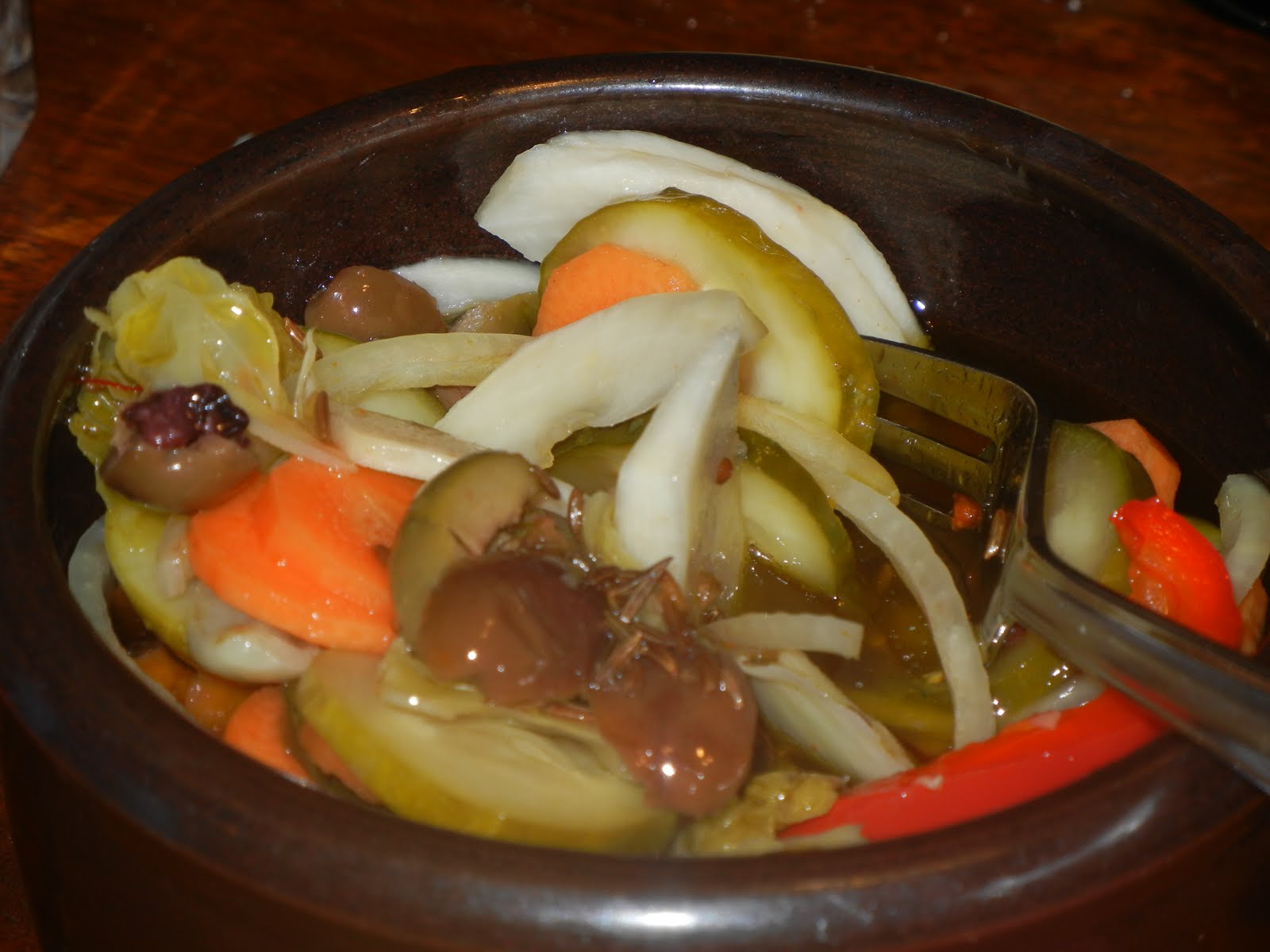
Moroccan Pickled Vegetables


As I said in the last post, I've been on a hunt for turnip recipes. I loved food52 a little more when I found many turnip recipes on there. One of those recipes was for pickled mixed vegetables. I made them, with many reservations. Two cups of olive oil? Only two pints of vegetables? Would we like them? Was my chili garlic sauce the right kind? Would it be too spicy with the chili garlic sauce?

Wouldn't you know it, it turned out ok! I was pleasantly surprised! I ended up using only 1 1/2 cups of olive oil and I still think it is a little too oily. The recipe made two quarts easily, and I even cut down on the amount of veggies I used. We've been eating with meals and have enjoyed it. In fact, I think I will probably even make it again.

A few additional notes on the recipe. If you use the amounts called for, which I am including, it will make probably four quarts. Just divide each layer on vegetables between four jars. This recipe also needs to sit for three days before serving. This sitting should take place at room temperature. After the initial three days, keep in the refrigerator for up to a month. The harissa also makes way more than you need. Refrigerate the extra for up to 3 months and use as you make new batches of pickled vegetables (or search for harissa recipes). Just keep it covered with a light film of olive oil.

Moroccan Pickled Vegetables
adapted from epicureanodyssey on food52.com

For the Harissa:
1 1/2 c Asian chile-garlic sauce
1 lg garlic clove, roughly chopped
1 T coriander
1 T caraway seeds
1 T dried mint (optional)
1 t kosher salt
1 T extra virgin olive oil

For the vegetables:
2 small cucumbers, unpeeled, sliced 1/4" thick
3 medium carrots, peeled, sliced 1/4" thick
2 medium turnips, peeled, halved, and cut into thin wedges
6 medium garlic cloves, peeled and lightly crushed
1 medium sweet onion, peeled, halved lengthwise and cut into thin strips
1/2 large red or yellow pepper, seeded and sliced
1/2 head green cabbage, cut in half, cored, and cut into 1/2" slices
6 oz mixed olives
2 lemons, halved, seeded and thinly sliced
4 thyme sprigs
1 t dried oregano
2 - 4 bay leaves
1 T caraway seeds, lightly crushed
1 T coriander seeds, lightly crushed
small pinch of saffron
2 T harissa

For the pickles:
1 1/4 c white vinegar
1 1/4 c apple cider vinegar
1 1/2 c extra virgin olive oil
2 T sugar
1 T kosher salt


For the harissa: Put all ingredients in a food processor and process to a paste. Set aside until you assemble the jars.

Divide the vegetables and herbs evenly between 4, 1-quart jars. Layer in the order listed in each jar. Top each with a little harissa. Meanwhile, in a medium saucepan, gently heat the olive oil, vinegars, sugar, and salt over medium-low heat until the sugar dissolves. Pour over the vegetable mixture. (Don't make it too hot or it will break the glass jars. If you think it is too hot or are worried about it, just let it cool a little before adding it). Cover and shake the jars to distribute the spices evenly.

Let set at room temperature for 3 days. Store in the refrigerator after that.

To serve, empty jar into a bowl. Top with some fresh feta if desired. (You can return uneaten portion to jar and eat another time).

Thursday, February 17, 2011

Beauty Paste Chicken with Roasted Root Vegetables


I've been on a Turnip binge lately. It hasn't been out of choice. They've been collecting in my crisper drawer in the fridge for a few months now. Occasionally, I'll make my yummy braised root vegetables as a side, but I am not a side lover. I would rather find a main course that can incorporate as many vegetables and parts of the meal as possible. Since Friday, I've made Homespun Potpie (with kohlrabi, turnips, and sweet potatoes--hold the chicken), Moroccan Vegetable Stew, and Beauty Paste Chicken with roasted vegetables (which included turnips). All of these meals, I've really enjoyed. I don't mind turnips, I just have a hard time remembering to use them. Needless to say, after all of this turnip binging, I've put a significant dent in my turnip collection, however, it is far from gone.

The Beauty Paste chicken was easy and the roasted vegetables were great. I tried the roasted vegetables two ways--one on a separate sheet pan below the roasting chicken and the other was in the roasting pan with the chicken. I liked them both ways, but I think I may have slightly preferred the roasting pan over the sheet pan. The potatoes developed their rich, buttery taste more in the roasting pan (maybe because the chicken was coated in butter?). The vegetables didn't quite all fit in the roasting pan, so more than likely, I'll do it both ways again next time.

I can't go wrong with making chicken for my kids. I can't go wrong with making roasted vegetables for me. We loved it (Curtis wasn't home this evening). I am looking forward to make chicken stock today with the bones and am scheming about what I may make with the leftover chicken (enchiladas, anyone?).

I was hesitant about using 5 T mustard powder. I only used 3 T, because that was all I had. The chicken could definitely handle 5 - 6 T, and if you are feeling really bold, find hot mustard powder (I wasn't because of M's sensitive tastes). I also inadvertently forgot the celery, I think because I was so excited about using more turnips.

This serves 4 - 6.

Beauty Paste Chicken with Roasted Vegetables
adapted from SaySchwartzandBeSure on Food52.com

5 T soft (mostly but not quite melted) butter
5 - 6 T dry mustard powder
1 T fresh thyme leaves
fresh ground black pepper
1 roaster chicken (3 - 5 lbs)

3 carrots, sliced 1/4" thick
2 leeks, white parts only, sliced 1/2" thick
2 celery stalks, cut into 2" chunks
2 medium white turnips (about the size of apples), cut into wedges
12 new red or white potatoes
1 red or sweet onion, cut into wedges
1 t sea salt
1/2 - 1 t lemon zest
fresh ground pepper
1 - 2 T olive oil

yellow onion, cut into quarters

Wash inside and out of chicken. Trim access fat. Pat dry and set aside.

Combine softened butter and mustard powder in a small bowl and whisk until smooth. Stir in pepper and fresh thyme. (If you've accidently melted the butter, let the butter/mustard combo stand at room temperature for a while). Set aside.

Combine the carrots, leeks, celery, turnips, potatoes, and red onion in a large bowl. Drizzle with olive oil and sprinkle with salt, pepper, and lemon zest. Toss to equally coat all the vegetables.

Sprinkle the inside of the chicken generously with salt and pepper. Stuff with yellow onion quarters. Using your hand, scoop the beauty paste all over the chicken in a thick layer. (The paste is what crisps the skin and keeps the chicken moist, don't skimp on this. If you run out of paste, make more). Place the chicken in a roasting pan. Surround the chicken with as many vegetables as well fit (you want the vegetables in a single to double layer at most. Don't fill the pan to the top with vegetables). Put remaining vegetables on a sheet pan.

Roast the chicken in a preheated 400 degrees oven for 20 minutes. Reduce the the heat to 350 and roast an additional 1 1/4 - 1 1/2 hours, depending on size and kind of chicken (organic vs free range vs conventional), until internal temp in the thickest part (between the thigh and leg) is 180 degrees. Let rest for 10 minutes before serving.

For the vegetables on the sheet pan, stir occasionally and remove from oven once they are tender. Warm right before serving the chicken and combine with the vegetables cooked in the roasting pan.

Monday, February 7, 2011

Minestrone Soup!!! With Cabbage!!!!

I have several minestrone soups in my collection already. What propelled me to try a new one though, was the presence of cabbage.

CSA's are unpredictable, or at least our CSA is. Last year, we got just a little cabbage, at the end of the season. This year, we get a head of cabbage a week, which for us, is a lot of cabbage. I've had a hard time staying ahead it. Last year, we got tons and tons of carrots. Yesterday we got 4 small ones (and in general the bunches have been smaller). I've been buying carrots at the store to handle our winter carrot eating habit. That's just how a CSA goes, I guess. I think I'd take the carrots over the all the cabbage though.

Anyway, I was excited about this recipe, even though I was unsure of it. The recipe called for uncooked, un-soaked dried beans to be used, which just seemed like blasphemy to me. Could the beans possibly be cooked without pre-soaking them? I tried, and for the most part, they were fine. The garbanzos were a little hard still, but very edible, and I found that the next day, the consistency was just right for them. If you can, buy the beans in bulk so you can just buy as much as you need. I liked using the Parmesan cheese rind which had been hanging out in my fridge for quite a while, waiting for a recipe like this.

The kids tried this and I think they would have liked it, except for the fact that it was too spicy. Yes, I managed to make minestrone soup too spicy. I agreed with them too and found an alternative for them without any qualms (normally, they eat what we are eating, unless I know ahead of time they probably won't like it or it ends up being too spicy). I have adapted the recipe some to take this into account.

Additonally, I think this recipe easily could be adapted to a slow-cooker if you would want to experiment. This recipe is time intensive, but not much work. It just requires at least 2 1/2 hours of cooking time, so save for a cold day.

This recipes feeds 4 - 6.

Minestrone Soup--With Cabbage!!!!
adapted from Foodwriter97426 on food52.com

1 med onion, chopped
4 cloves garlic, minced
olive oil
3/4 c dry cannellini beans
1/4 c dry garbanzo beans
6 c water
1 bay leaf
2 t fresh thyme, chopped
2 t fresh rosemary, chopped
2 t fresh oregano, chopped
1 1/2 t salt
a dash of black pepper
1 c green beans, cut into 1 - 2 inch pieces (I use frozen)
1 c carrots, coarsely diced
1 can diced tomatoes (with juice)
2" piece Parmesan cheese rind
10 oz of cabbage, thinly sliced
1/3 c small pasta
1/2 c red wine

Saute onions in a little oil in a large soup pot over medium heat until onions are translucent. Add the garlic and saute another minute. Add the beans, water and by leaf. Bring to a boil, and then reduce the heat to low. Simmer for 1 1/2 hrs or until beans are just barely tender. Add thyme, rosemary, oregano, salt, dash of pepper, green beans, carrots, tomatoes, and cheese rind. Return to a boil, then cover and continue to simmer another 30 minutes over low heat. Add cabbage and pasta to the pot. If the soup looks dry at any time, add up to an additional 1 1/2 c of water. Simmer, uncovered, another 30 minutes. Add wine, and taste for seasoning, adding more salt and pepper, if desired. Serve topped with some extra grated Parmesan.

Thursday, January 20, 2011

Carrot White Bean Dill Salad

When I ditched my Swedish Lamb Stew the other night, I needed an outlet for my dill--the CSA produce on the menu for that evening. I Goggled it and found a recipe from a blog I'd heard of, but never really checked out before, 101 cookbooks. For those not familiar with food blog history, 101 Cookbooks is one of the food blog pioneers, starting way back in 2003. (I am not a food blog historian, by any stretch of the imagination, this is my own distinction that I came up with almost no research). 101 Cookbooks focus is on natural foods--a lot of unrefined grains and sugars and all vegetarian recipes. It hasn't made my bookmark bar yet, but it still may. The pictures are beautiful and the layout is great (versus, say, this blog). :)

Curtis and I loved this salad (again, this was the evening our kids ate just beets for supper). It does a great job of using ingredients that are in season together.

These proportions will serve about 3 - 4 people as a side. (The original recipe would serve 6 - 8).

Carrot White Bean Dill Salad
from 101 Cookbooks

2 T extra virgin olive oil
1 1/2 T fresh lemon juice
dash of salt
2 T - 1/4 c thinly sliced shallots, to taste (I am not a huge raw onion--even shallot--fan).

1 c carrots, sliced 1/4" thick on deep bias (which means diagonally)
1 (15-oz) can white beans
2 T fresh dill, chopped
1 T brown sugar
3 T sliced almonds, toasted

Combine olive oil, lemon juice, salt, and shallots in a small bowl. Stir and set aside.

In a large skillet over medium high heat, toss the carrots with a little olive oil. Spread them out in a single layer in the skillet. Cook them 12 minutes, tossing every three to four minutes, or until carrots are very browned.Add the beans and dill to the skillet, and cook another 5 minutes, or until beans are heated through. Add more olive oil to the pan if the pan looks dry and the beans are sticking.

Transfer beans/carrots mixture to a medium bowl. Sprinkle with brown sugar and pour 3/4 of the shallot/olive oil dressing over top. Toss gently. Let sit for 10 minutes, then toss gently again. Taste and adjust seasonings if needed. Sprinkle with almonds just before serving. Serve warm or at room temperature.

Wednesday, January 12, 2011

Maple Glazed Root Vegetables

I like cold-weather produce. Most of it stores well and is packed with a whopper of a nutritional punch. I don't stress about how many weeks my root vegetables have languished in my fridge---carrots, turnips, beets, rutubagas, radishes, kohlrabi will hang out for quite a while before they go bad. That's a good thing.

Occasionally, I come across a recipe like this which lets me use a bunch of root veggies at once. I raid the root vegetable drawer and drastically increase the amount of real estate in the crisper drawers. The amounts of vegetables in this recipe is kinda loosey-goosey. You don't have to use all these vegetables. Say if you have lots of turnips and sweet potatoes, don't go and buy a rutubaga for this (I wonder why anyone would ever pay for a rutubaga. It's definitely not one of my favorite roots). I know my vegetables weren't the size they were imagining--I had baby farm carrots, not big grocery store ones and small Hakerui Salad Turnips. I guessed amounts. You could also throw a parsnip in there if you had one. I didn't so I left it out. Just cut it into 2" pieces (about 1 c worth).

This recipe works perfectly on a rack in the oven sitting beneath a roasting chicken. Mmmm...I didn't actually eat these with supper, at which point I was a little unhappy because I doubted the restaurant I was going to could beat these (they couldn't). The tastes I had were great though and I can't wait to eat the leftovers.

This serves 4 - 6 as a side dish.

Maple-Glazed Roasted Root Vegetables
adapted Williams-Sonoma Cooking from the Farmers' Market

2 carrots, cut into 2" pieces (if using smaller carrots use 3 or 4)
5 - 6 small Hakerui Salad Turnips, cut into halves and quarters or 1 larger traditional turnip, cut into 2" pieces (I'd say about 2 c worth)
1/2 rutubaga, peeled and cut into 2" pieces (about 2 c worth)
1 sweet potato, peeled and cut into 2" pieces (about 2 c worth)
1 red onion, cut into wedges (about 1 1/2 c worth)
2 - 3 T olive oil
salt
1/4 c maple syrup (not Aunt Jemima type pancake syrup folks. Use the real thing!)
2 T butter, melted

In a large bowl, toss together all the vegetables with olive oil to coat. Season with 2 t salt and toss again. Spread the vegetables on a single layer on cookie sheet (with a silcone mat makes for much easier clean up). If they won't all fit on one, use two sheets (I had no problem with them all comfortably fitting on one without crowding). Roast vegetables in a preheated 400 degrees oven for 40 - 50 minutes until they develop a light crust and are tender. If you are using the oven for say a roasted chicken as well and the roast chicken is in a 425 degrees oven, just leave the oven set at 425 and start checking your vegetables earlier for tenderness. Occasionally stir and shake the pans to crisp sides of vegetables and prevent sticking.

While the vegetables roast, stir together maple syrup and butter in a small bowl. Brush over tender vegetables, return vegetables to oven and roast another 5 minutes, or until vegetables look glazed. Serve immediately.