After a self-imposed cookbook moratorium for a while, I got a couple new cookbooks this spring. I have been so thankful I did. The first one was Ruth Riechl's My Kitchen Year. Seriously folks, we have loved almost every recipe I've made from here (and I've made a few).
Last night, the recipe was a caramelized pork. A brief disclaimer. I ignored the advice Reichl gave at the bottom of the recipe which was to not double the recipe. However, I had to. The recipe served two and I have five hearty eaters. My end product may not have turned out exactly like hers did, but we all still loved it. At the end of the meal, I had multiple people telling me to make this again.
Serves 4 - 6.
Caramelized Vietnamese Pork
adapted slightly from My Kitchen Year by Ruth Reichl
2 T rice vinegar
1 t sugar
1 medium to large cucumber, peeled, seeds removed, halved and cut into half moons
1 inch piece fresh ginger, peeled and thinly sliced
1 1/2 - 2 lbs pork tenderloin, thinly sliced (easiest done if pork is at least partially frozen)
2 small onions, thinly sliced
2 cloves garlic, smashed
2 T sugar
1/4 c fish sauce
fresh mint, coarsely chopped (about 2-3 sprigs)
fresh basil, coarsely chopped (about 2 -3 sprigs)
chili garlic sauce or sriracha
crushed peanuts (optional)
lime wedges
cooked rice to serve 4 - 6
Pour rice vinegar in a bowl and add 1 t sugar and a pinch of salt. Gently stir in cucumber and ginger Allow to soak while you make the meat.
Heat a wok over medium-high to high heat. A water droplet should dance on the surface of the wok and then disappear. Add some grapeseed, peanut or similar oil and toss in onion and garlic. As soon as the onion and garlic are nice and fragrant, add the pork and 2 T sugar. Stir-fry, tossing every few minutes for 10 - 15 minutes, or until the pork has crisped into little bits (I never achieved this due to an overfull wok. After the pork had cooked for a bit, I poured the extra juice off the bottom of the wok to give the pork a chance to brown. I simply cooked the pork until it began to brown. We were hungry, I was out of patience, and didn't want to burn the meat).
Take the wok off the heat and stir in fish sauce until it is absorbed. Season with black pepper. Remove the ginger slices from the cucumber. Add the cucumber slices and the marinade to the pork. Stir.
Serve with rice. Top with mint and basil (necessary for a more Vietnamese taste), chili garlic sauce if desired, lime wedges, and crushed peanuts, if desired.
Showing posts with label Cucumbers. Show all posts
Showing posts with label Cucumbers. Show all posts
Tuesday, June 14, 2016

Wednesday, August 14, 2013
Sabih
This is quick becoming one of our summer favorites (up there with Bun Chay, Taco Salad, and Sicilian Stir Fry). Despite doing this CSA thing for the past five plus years, our kids are still not fans of eggplant and zucchini. Curtis and I are still kinda iffy on both of those as well, especially zucchini.
Well, this recipe has no zucchini. It does use eggplant and cucumbers. We love this and have adapted it to the kids by also adding some grilled marinated chicken breasts. Everyone's happy. First bite and once again, I remember how wonderful summer can be.
This recipe calls for savory mango pickles. Some day, I hope to have the time to locate those (I know what store to look at, I just haven't braved it this summer with three kids in tow), so I am leaving them in the recipe.
Sabih
adapted from Jerusalem by Yotam Ottolenghi and Sami Tamimi
2 large eggplants (or 3 - 4 small or medium ones), peeled leaving a zebra like pattern (one strip peeled, one peel left on, etc)
1 1/4 c sunflower or canola oil
1/2 - 1 lb seasoned chicken breasts
sourdough bread, ciabatta bread, or fresh pita (I usually use bread)
4 hard boiled eggs, peeled and sliced
savory mango pickle (optional)
2 medium ripe tomatoes, diced
2 small cucumbers (1 med-lg), diced (if you use a large one, peel and seed cucumber as well)
1 1/2 T parsley
lemon slices
Tahini Sauce:
2/3 c tahini
1/2 c water
2 T lemon juice
salt
1 clove garlic, crushed (optional)
Zhoug:
1 1/4 oz cilantro (thin stems ok)
1/3 oz parsley (thin stems ok)
1 - 2 hot green chiles, coarsely chopped
1/2 t cumin
1/4 t cardamom
1/4 t cloves
pinch of sugar
1/4 t salt
1 clove garlic, crushed (optional)
2 T olive oil
2 T water
Cut eggplants widthwise into slices 1 inch thick. Sprinkle them on both sides with salt, spread on baking sheet or kitchen towel, and let stand for at least 30 minutes (this helps remove some of the water). Pat dry with paper towels or clean kitchen towels.
While the eggplants sweat, prepare the tahini sauce. In a small bowl, combine tahini, water, and lemon juice. The consistency should be of honey or a little runnier. Add a little extra water if needed. Taste and add salt as desired. Sauce can be store in the fridge for up to a week, just stir well before using (and add a little more water if needed).
Prepare the zhoug. Finely chop all the zhoug ingredients (not including olive oil or water). Add the water and olive oil and combine to make a coarse paste. If you have a small food processor, you could also pulse all the ingredients (including olive oil and water) until you have a coarse paste. Zhoug will keep in the fridge for up to three weeks (but ours never lasts that long!).
After the eggplant have sweated for 30 minutes or so, heat the sunflower or canola oil in a heavy frying pan. Make sure the oil is very hot (it almost looks like it starts swirling around in the pan by itself, it shouldn't smoke though, and you definitely don't want it catching on fire) and fry the eggplant slices in batches until nice and dark. Flip the eggplants once. Add oil if needed. When the eggplant is done, it should be nice and squishy in the center. Remove and drain on paper towels. While the eggplant fries, grill the chicken.
To serve: Slice the chicken into thin strips. Put the hardboiled eggs, diced tomatoes, diced cucumbers, and mango pickles on a platter. I don't mix things together because we all like different combinations. Put the parsley in a little bowl and serve the lemon slices as well.
Make the eggplant and chicken into open-faced sandwiches. Spoon tahini sauce over the bread. Follow with eggplant slices (or chicken), some more tahini sauce, eggs, tomato, cucumbers, and top with zhoug. If desired, you can squeeze a lemon over top or season with salt and pepper.
Well, this recipe has no zucchini. It does use eggplant and cucumbers. We love this and have adapted it to the kids by also adding some grilled marinated chicken breasts. Everyone's happy. First bite and once again, I remember how wonderful summer can be.
This recipe calls for savory mango pickles. Some day, I hope to have the time to locate those (I know what store to look at, I just haven't braved it this summer with three kids in tow), so I am leaving them in the recipe.
Sabih
adapted from Jerusalem by Yotam Ottolenghi and Sami Tamimi
2 large eggplants (or 3 - 4 small or medium ones), peeled leaving a zebra like pattern (one strip peeled, one peel left on, etc)
1 1/4 c sunflower or canola oil
1/2 - 1 lb seasoned chicken breasts
sourdough bread, ciabatta bread, or fresh pita (I usually use bread)
4 hard boiled eggs, peeled and sliced
savory mango pickle (optional)
2 medium ripe tomatoes, diced
2 small cucumbers (1 med-lg), diced (if you use a large one, peel and seed cucumber as well)
1 1/2 T parsley
lemon slices
Tahini Sauce:
2/3 c tahini
1/2 c water
2 T lemon juice
salt
1 clove garlic, crushed (optional)
Zhoug:
1 1/4 oz cilantro (thin stems ok)
1/3 oz parsley (thin stems ok)
1 - 2 hot green chiles, coarsely chopped
1/2 t cumin
1/4 t cardamom
1/4 t cloves
pinch of sugar
1/4 t salt
1 clove garlic, crushed (optional)
2 T olive oil
2 T water
Cut eggplants widthwise into slices 1 inch thick. Sprinkle them on both sides with salt, spread on baking sheet or kitchen towel, and let stand for at least 30 minutes (this helps remove some of the water). Pat dry with paper towels or clean kitchen towels.
While the eggplants sweat, prepare the tahini sauce. In a small bowl, combine tahini, water, and lemon juice. The consistency should be of honey or a little runnier. Add a little extra water if needed. Taste and add salt as desired. Sauce can be store in the fridge for up to a week, just stir well before using (and add a little more water if needed).
Prepare the zhoug. Finely chop all the zhoug ingredients (not including olive oil or water). Add the water and olive oil and combine to make a coarse paste. If you have a small food processor, you could also pulse all the ingredients (including olive oil and water) until you have a coarse paste. Zhoug will keep in the fridge for up to three weeks (but ours never lasts that long!).
After the eggplant have sweated for 30 minutes or so, heat the sunflower or canola oil in a heavy frying pan. Make sure the oil is very hot (it almost looks like it starts swirling around in the pan by itself, it shouldn't smoke though, and you definitely don't want it catching on fire) and fry the eggplant slices in batches until nice and dark. Flip the eggplants once. Add oil if needed. When the eggplant is done, it should be nice and squishy in the center. Remove and drain on paper towels. While the eggplant fries, grill the chicken.
To serve: Slice the chicken into thin strips. Put the hardboiled eggs, diced tomatoes, diced cucumbers, and mango pickles on a platter. I don't mix things together because we all like different combinations. Put the parsley in a little bowl and serve the lemon slices as well.
Make the eggplant and chicken into open-faced sandwiches. Spoon tahini sauce over the bread. Follow with eggplant slices (or chicken), some more tahini sauce, eggs, tomato, cucumbers, and top with zhoug. If desired, you can squeeze a lemon over top or season with salt and pepper.
Tuesday, August 6, 2013
Spiced Chickpeas and Summer Vegetable Salad
I know it's been a long time since I've added any recipes. A usual, its a new cookbook that causes me to start adding recipes. For Christmas this year, the dog gave me a cookbook again. Her choice was superb: Jerusalem by Yotam Ottolenghi and Sami Tamimi. I want to be sure next summer when I am scrambling to come up with recipes using eggplant, cucumbers, and the likes, I remember these recipes.
Normally I shy away from cookbooks by restaurant owners or Food Network personalities. They seem full of themselves and full of ingredients that are either terribly expensive or terribly hard to find. Not so for Jerusalem. Although Ottolenghi owns restaurants bearing his name in London, the recipes are easily accessible. The recipes are mostly kosher and heavy on vegetables. Many of the summer vegetables use limited stove/oven time as well, which is nice when it's over 100 degrees outside and I really don't want to heat up my oven any more.
This the first recipe to share. We love it, especially the spiced chickpeas. My margin note? "The spiced chickpeas are divine!" I made a few changes. The original recipe called for a dressing on top of the vegetables. I left that out. Additionally, because with five people we are bound to like different things, I did not mix the vegetables together, I left them in separate piles on the serving platter. I used the vegetables I had (two kinds of sweet peppers), I omitted those I didn't (radishes).
Remember to start the chickpeas the night before you want to eat this meal.
This serves 4.
Spiced Chickpeas and Summer Vegetable Salad
adapted from Jerusalem by Ottolenghi and Tamimi
1/2 c dried chickpeas
1 t baking soda
2 small cucumbers, cut into 2/3" dice (seed and peel if you prefer)
2 large tomatoes, cut into 2/3" dice
8.5 oz radishes, cut into 2/3" dice (optional)
1 -2 sweet peppers, seeded and ribs removed, cut into 2/3" dice
2/3 oz cilantro, coarsely chopped
1/2 oz parsley, coarsely chopped
1 t ground cardamom
1 1/2 t allspice
1 t cumin
1/4 t salt
Greek yogurt
pita
Soak the chickpeas overnight in a large bowl with plenty of cold water and baking soda. The next day, drain, place in a large saucepan and cover with water twice the volume of the chickpeas. Bring to a boil and simmer, skimming off any foam that may gather on top. Simmer for an hour or until the chickpeas are tender. Drain and set aside.
Mix the cardamom, allspice, cumin, and salt on a plate. Roll the cooked chickpeas gently through the spices. Heat 1 T olive oil in a frying pan over medium heat. Add the chickpeas and fry for 2 - 5 minutes. Gently shake the pan so they cook evenly and don't stick. Remove from heat and keep warm
To serve, put each vegetable on a serving platter. (Alternately, combine all the vegetables and herbs and place in a low bowl. Top with warm chickpeas.) Serve the chickpeas in a small bowl. Allow everyone to take the vegetables they want and top with chickpeas. Serve with pita and drizzle Greek yogurt over top if desired.
Normally I shy away from cookbooks by restaurant owners or Food Network personalities. They seem full of themselves and full of ingredients that are either terribly expensive or terribly hard to find. Not so for Jerusalem. Although Ottolenghi owns restaurants bearing his name in London, the recipes are easily accessible. The recipes are mostly kosher and heavy on vegetables. Many of the summer vegetables use limited stove/oven time as well, which is nice when it's over 100 degrees outside and I really don't want to heat up my oven any more.
This the first recipe to share. We love it, especially the spiced chickpeas. My margin note? "The spiced chickpeas are divine!" I made a few changes. The original recipe called for a dressing on top of the vegetables. I left that out. Additionally, because with five people we are bound to like different things, I did not mix the vegetables together, I left them in separate piles on the serving platter. I used the vegetables I had (two kinds of sweet peppers), I omitted those I didn't (radishes).
Remember to start the chickpeas the night before you want to eat this meal.
This serves 4.
Spiced Chickpeas and Summer Vegetable Salad
adapted from Jerusalem by Ottolenghi and Tamimi
1/2 c dried chickpeas
1 t baking soda
2 small cucumbers, cut into 2/3" dice (seed and peel if you prefer)
2 large tomatoes, cut into 2/3" dice
8.5 oz radishes, cut into 2/3" dice (optional)
1 -2 sweet peppers, seeded and ribs removed, cut into 2/3" dice
2/3 oz cilantro, coarsely chopped
1/2 oz parsley, coarsely chopped
1 t ground cardamom
1 1/2 t allspice
1 t cumin
1/4 t salt
Greek yogurt
pita
Soak the chickpeas overnight in a large bowl with plenty of cold water and baking soda. The next day, drain, place in a large saucepan and cover with water twice the volume of the chickpeas. Bring to a boil and simmer, skimming off any foam that may gather on top. Simmer for an hour or until the chickpeas are tender. Drain and set aside.
Mix the cardamom, allspice, cumin, and salt on a plate. Roll the cooked chickpeas gently through the spices. Heat 1 T olive oil in a frying pan over medium heat. Add the chickpeas and fry for 2 - 5 minutes. Gently shake the pan so they cook evenly and don't stick. Remove from heat and keep warm
To serve, put each vegetable on a serving platter. (Alternately, combine all the vegetables and herbs and place in a low bowl. Top with warm chickpeas.) Serve the chickpeas in a small bowl. Allow everyone to take the vegetables they want and top with chickpeas. Serve with pita and drizzle Greek yogurt over top if desired.
Tuesday, October 9, 2012
Bun Chay
Alas that you think I am out of recipes with fish sauce, let me reassure you that I am not! This has been another easy, go-to summer recipe.
Here in ATX (also known as Austin, Texas), fall does not start just because a calendar says it should. Instead, summer lingers...with temperatures in the 90's all through September and a few days in the 90's sprinkled into October as well. Summer produce is still in full swing---with our CSA box being loaded with eggplant, peppers, summer squash, and zucchini.
Thus, I am still cooking summer recipes. I love this salad, plus its low calorie and low fat, which is always a plus. Just like the taco salad, the kids are a bit hesitant because of the all the lettuce, but they'll eat the noodles no problem.
This serves 4 - 6.
Bun Chay
adapted from thekitchn.com
1 lb tofu, pressed to remove extra water (place under a weighted plate for 30 minutes)
1/2 lb dried rice sticks or vermicelli
head of Romaine lettuce (3+ cups)
1 c cucumber, julienned
large handfuls of basil, mint, and cilantro, coarsely chopped
1/4 c fresh lime juice
1/4 c fish sauce or soy sauce (soy sauce will keep this recipe vegetarian/vegan)
1/4 c sugar
1/2 c water
1/4 c peanuts, chopped
Fry the tofu in a some vegetable oil heated in a large pan (you can either pan fry the tofu, using just a bit of oil or deep fry the tofu, using enough hot oil to cover the tofu). Drain excess oil and set aside.
Meanwhile, cook the noodles in a large pot of boiling water according to the package directions. Drain and rinse under cold water, separating the strands. Drain completely.
In a little jar, combine the lime juice, fish sauce (soy sauce), sugar, and water. Shake vigorously to combine.
To assemble the salad, place the lettuce in a large bowl and sprinkle with the fresh herbs. Toss with the cucumbers and tofu. Top with noodles and cucumbers and gently toss. Drizzle the salad with the sauce to taste. Serve and sprinkle with chopped peanuts if desired.
Here in ATX (also known as Austin, Texas), fall does not start just because a calendar says it should. Instead, summer lingers...with temperatures in the 90's all through September and a few days in the 90's sprinkled into October as well. Summer produce is still in full swing---with our CSA box being loaded with eggplant, peppers, summer squash, and zucchini.
Thus, I am still cooking summer recipes. I love this salad, plus its low calorie and low fat, which is always a plus. Just like the taco salad, the kids are a bit hesitant because of the all the lettuce, but they'll eat the noodles no problem.
This serves 4 - 6.
Bun Chay
adapted from thekitchn.com
1 lb tofu, pressed to remove extra water (place under a weighted plate for 30 minutes)
1/2 lb dried rice sticks or vermicelli
head of Romaine lettuce (3+ cups)
1 c cucumber, julienned
large handfuls of basil, mint, and cilantro, coarsely chopped
1/4 c fresh lime juice
1/4 c fish sauce or soy sauce (soy sauce will keep this recipe vegetarian/vegan)
1/4 c sugar
1/2 c water
1/4 c peanuts, chopped
Fry the tofu in a some vegetable oil heated in a large pan (you can either pan fry the tofu, using just a bit of oil or deep fry the tofu, using enough hot oil to cover the tofu). Drain excess oil and set aside.
Meanwhile, cook the noodles in a large pot of boiling water according to the package directions. Drain and rinse under cold water, separating the strands. Drain completely.
In a little jar, combine the lime juice, fish sauce (soy sauce), sugar, and water. Shake vigorously to combine.
To assemble the salad, place the lettuce in a large bowl and sprinkle with the fresh herbs. Toss with the cucumbers and tofu. Top with noodles and cucumbers and gently toss. Drizzle the salad with the sauce to taste. Serve and sprinkle with chopped peanuts if desired.
Tuesday, February 22, 2011
Moroccan Pickled Vegetables
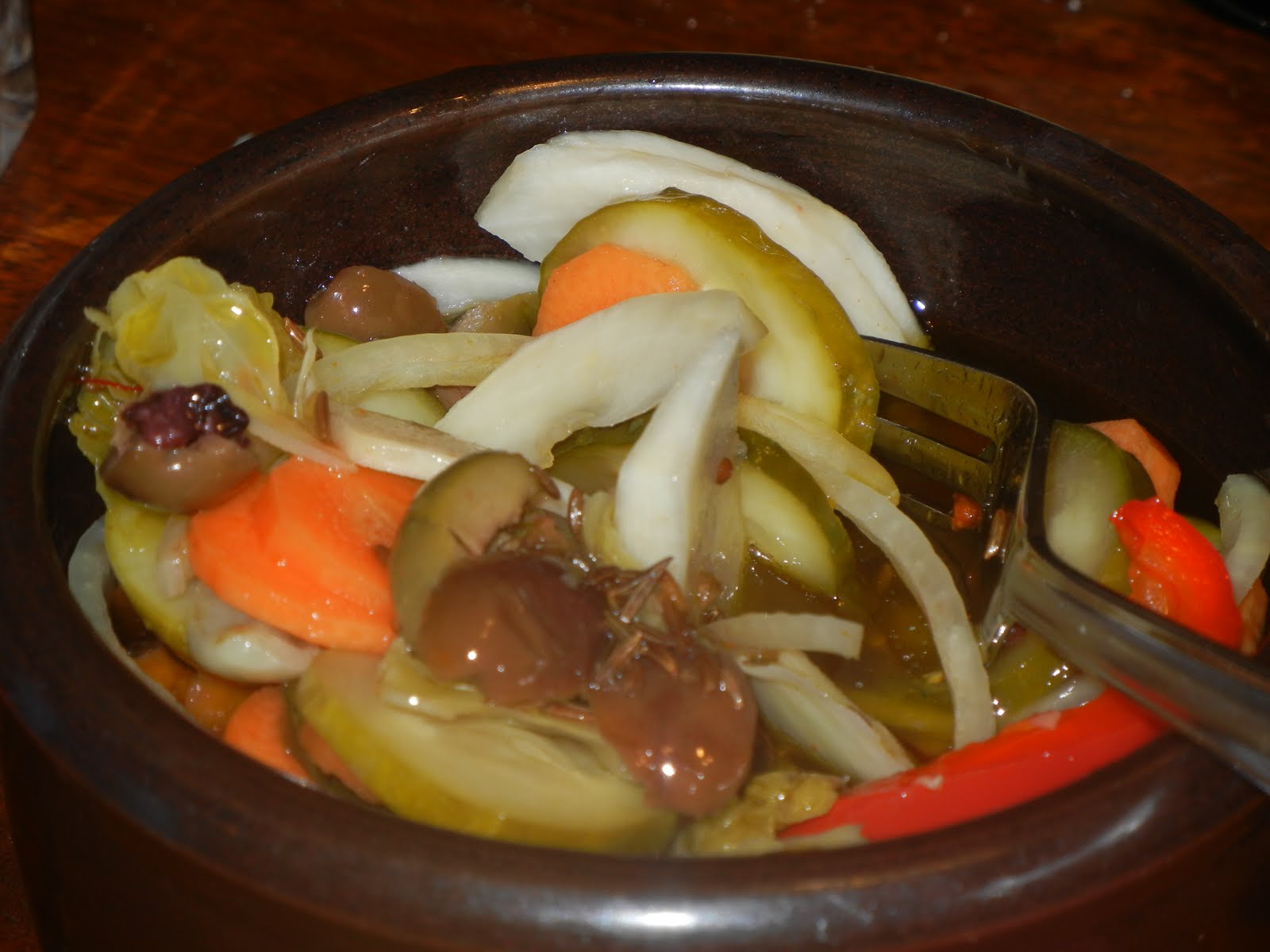
As I said in the last post, I've been on a hunt for turnip recipes. I loved food52 a little more when I found many turnip recipes on there. One of those recipes was for pickled mixed vegetables. I made them, with many reservations. Two cups of olive oil? Only two pints of vegetables? Would we like them? Was my chili garlic sauce the right kind? Would it be too spicy with the chili garlic sauce?
Wouldn't you know it, it turned out ok! I was pleasantly surprised! I ended up using only 1 1/2 cups of olive oil and I still think it is a little too oily. The recipe made two quarts easily, and I even cut down on the amount of veggies I used. We've been eating with meals and have enjoyed it. In fact, I think I will probably even make it again.
A few additional notes on the recipe. If you use the amounts called for, which I am including, it will make probably four quarts. Just divide each layer on vegetables between four jars. This recipe also needs to sit for three days before serving. This sitting should take place at room temperature. After the initial three days, keep in the refrigerator for up to a month. The harissa also makes way more than you need. Refrigerate the extra for up to 3 months and use as you make new batches of pickled vegetables (or search for harissa recipes). Just keep it covered with a light film of olive oil.
Moroccan Pickled Vegetables
adapted from epicureanodyssey on food52.com
For the Harissa:
1 1/2 c Asian chile-garlic sauce
1 lg garlic clove, roughly chopped
1 T coriander
1 T caraway seeds
1 T dried mint (optional)
1 t kosher salt
1 T extra virgin olive oil
For the vegetables:
2 small cucumbers, unpeeled, sliced 1/4" thick
3 medium carrots, peeled, sliced 1/4" thick
2 medium turnips, peeled, halved, and cut into thin wedges
6 medium garlic cloves, peeled and lightly crushed
1 medium sweet onion, peeled, halved lengthwise and cut into thin strips
1/2 large red or yellow pepper, seeded and sliced
1/2 head green cabbage, cut in half, cored, and cut into 1/2" slices
6 oz mixed olives
2 lemons, halved, seeded and thinly sliced
4 thyme sprigs
1 t dried oregano
2 - 4 bay leaves
1 T caraway seeds, lightly crushed
1 T coriander seeds, lightly crushed
small pinch of saffron
2 T harissa
For the pickles:
1 1/4 c white vinegar
1 1/4 c apple cider vinegar
1 1/2 c extra virgin olive oil
2 T sugar
1 T kosher salt
For the harissa: Put all ingredients in a food processor and process to a paste. Set aside until you assemble the jars.
Divide the vegetables and herbs evenly between 4, 1-quart jars. Layer in the order listed in each jar. Top each with a little harissa. Meanwhile, in a medium saucepan, gently heat the olive oil, vinegars, sugar, and salt over medium-low heat until the sugar dissolves. Pour over the vegetable mixture. (Don't make it too hot or it will break the glass jars. If you think it is too hot or are worried about it, just let it cool a little before adding it). Cover and shake the jars to distribute the spices evenly.
Let set at room temperature for 3 days. Store in the refrigerator after that.
To serve, empty jar into a bowl. Top with some fresh feta if desired. (You can return uneaten portion to jar and eat another time).
Friday, July 23, 2010
Tzatziki

As you've been able to tell by now, I am on a Mediterranean, Greek, in particular, kick this summer. My discovery of how easy it is to make pita bread and remembering how easy it is to use eggplant that's accumulated by making baba ganoush, has made me search for other Greek recipes. This week's new addition was Tzatziki.
I don't like cucumbers. Not a bit. Maybe if they're pickled just right, but that is the only way. So far this summer, I've been able to use all of our CSA cucumbers by feeding them to M, J, and Curtis. They're slowing down on their cucumber consumption though, so I needed to find another way to use my remaining pound of cucs before I got my new box today.
Thus tzatziki. I whipped up a batch of pita, grilled some chicken souvlaki (recipe coming), and made tzatziki to accompany it (along with diced tomatoes, and roasted mild chile peppers). Tzatziki is basically pretty easy to make, the hardest part is slicing the cucumbers. The rest of the process pretty much involves waiting and not much else.
Unbelievably, I actually liked tzatziki. I put it on my chicken souvlaki pita and enjoyed the tartness of the lemon and yogurt and freshness of the dill. I did my best to totally ignore the cucumbers (although I did like the slight crunch they provided).
Follow this recipe closely, it's not difficult but in order to avoid runny tzatziki you need let the salt pull the water out of the cucumbers and the liquid drain out of the yogurt. Do those steps and you will have wonderful tzatziki.
This recipe makes 2 cups.
Tzatziki
adapted slightly from Serious Eats
1 lb cucumbers, ends removed and sliced lengthwise
2 c plain yogurt
2 cloves garlic, minced
1 large handful of dill, minced (about 1/4 - 1/3 c)
juice of 1 lemon
Scoop out cucumber seeds with a spoon. Slice each half lengthwise to have 1/2" wide strips (about 4 - 8 long strips per cucumber depending on cucumbers thickness. If they are young, small cucumbers, you probably can skip this step). Thinly slice the cucumber strips, not paper thin, but less than 1/4" thick. Lay out a dish towel or paper towels on the counter. Spread out the cucumbers in an even layer on the towel. Sprinkle generously with salt.
 If the cucumbers don't look glossy and moist after a few minutes, sprinkle more salt on them. Let them salt for a half hour. Pat the cucumbers dry with a dish towel.
Meanwhile, line a fine sieve with cheesecloth, a paper towel, or a coffee filter. Put the yogurt in the lined sieve and let set for 15 minutes to allow the excess moisture to seep out. Discard excess moisture.
Mix together, yogurt, cucumbers, dill, lemon, and garlic. Taste and adjust seasonings, adding a little more salt, if necessary. It is preferable for this to be refrigerated for a few hours before serving to let flavors marry, but it is just fine if eaten immediately.
Saturday, July 17, 2010
Tabbouleh and our Mezze Meal

As mentioned the other day, I made pita for our mezze meal. Mezze is like Spanish Tapas except in Mediterranean places like Greece, Turkey, and the Middle East (so the Eastern Med. instead of Western Med like where Spain, France, and Italy are). In addition to pita, we had hummus, caponata (again, I know, Italy--it didn't quite fit either), cherry tomatoes--a handful of which were off of my tomato plants, cucumber slices, and tabbouleh. I knew my kids wouldn't really go for the caponata or tabbouleh and from the above picture, you can see I am right (pictured above is M's plate).
I made tabbouleh, for the first time in many, many years. I kinda overdosed on tabbouleh several years ago. I also used old bulgur the last time I made it and cucumbers (if you remember, I am NOT a cucumber fan). This time I was sure to chuck my two year old bulgur (if it smells a little rancid or old, don't use it!!) and find a new recipe that omits the cucumbers. As a result, I love tabbouleh again. We've had it for a side for a couple meals since my mezze meal and it's been perfect.
This makes 4 c of tabbouleh.

Tabbouleh
adapted from The Kitchn
1 c bulgur wheat
1 1/2 c boiling water
2 cloves garlic, finely chopped
1/2 red onion, finely chopped
2 large bunches (Italian, if possible) parsley, finely chopped
1/2 c mint leaves, finely chopped
1/2 large tomato, minced fine
about 1/2 c lemon juice (from 3 lemons)
2 T olive oil
salt and pepper to taste
Put bulgur wheat in a large bowl. Pour the boiling water over it, cover, and put in the fridge for an hour to soften.
Add the onion, garlic, parsley, mint, tomato, lemon juice, olive oil, and salt and pepper to the wheat. Mix well, taste and season accordingly. For best flavor, cover and refrigerate overnight to let the flavors marry. However, if you make this just an hour or less before you want to eat it like I did, it will taste just fine.
Alternate method: use a food processor to finely chop first onion and garlic. Remove onion and garlic and then process parsley and mint. Add to wheat along with other ingredients.
If you like cucumbers more than I do, you can add 1 cucumber that has been peeled, seeded, and minced. I don't know why you would want to do that, but I'm just letting you know that some people may think it's good.
Tuesday, June 9, 2009
Gazpacho

Mmm...gazpacho. Gazpacho has to be my absolute favorite way to use cucumber (I don't like cucumbers...). Only Curtis and I like it, which is fine. I usually eat it for lunches for a week while the kids eat their PB & J sandwiches (and cucumbers and cherries, as M did today). It's light and refreshing for these hot Texas days.
A few recipe notes--you can make this as thin or thick as you like. I puree half the cucumber, bell pepper and parsley. If you want a chunkier soup, don't puree. If you want a thin soup, puree the whole thing. This time I also added one of the thin yellow peppers I've been getting from our CSA--it added a little extra flavor. This is a recipe to experiment with. Make it several times until you come up with exactly what you are looking for. Regarding the color of the soup (in the picture)--I used canned tomato juice which I made out of a combination of red and yellow tomatoes last year so the juice wasn't as bright red as sometimes. Puree the vegetables also makes the soup less red--for a redder soup, don't puree anything. I would also suggest adding the honey last. My gazpacho was a little sweet this time because of how naturally sweet the tomato juice. Only add the honey if it needs a little extra sweetness.
Gazpacho
adapted from a recipe from one of the Moosewood Cookbooks
4 c tomato juice
1/2 c onion, finely minced
1 clove garlic, minced
1 medium bell pepper, minced
1 t honey (opt)
1 medium cucumber, peeled, seeded, and minced
2 scallions, minced
1/2 - 1 lemon, juiced (to taste)
1 lime, juiced
1 t tarragon
1 t dried basil (1 T fresh)
1/2 t cumin
1/4 c fresh parsley, minced
2 T olive oil
salt, to taste
black pepper, to taste
cayenne pepper, to taste
2 c fresh tomatoes, diced
Combine tomato juice, onion, garlic, 1/2 of bell pepper, honey, lemon juice, lime juice, tarragon, basil, olive oil, salt, black pepper, and cayenne. Puree in blender or food processor. Add 1/2 of cucumber, 1/2 of scallions, and 1/2 of parsley to pureed mixture. Puree (for a chunky soup, just add all of remaining ingredients and serve---skip the second puree). Add all the remaining ingredients. Chill and serve cold.
Sunday, September 28, 2008
Shrimp Scampi with Gazpacho Salsa
I decided to celebrate having my family back together this evening with Shrimp Scampi. I also found a great recipe on Epicurious for Gazpacho Salsa which I thought would go great on top of it (plus, it used cucumbers in chunks big enough for me to pick out). I made the salsa first to let the flavors "marry," and I knew the Shrimp Scampi I would need to pay attention the whole time I was cooking it. I am not including the recipe for the salsa, but have included a link to Epicurious's website. A quick note on the salsa recipe. Be sure to use smoked paprika. That makes the salsa spectacular. Again, that's a good ingredient to buy in the bulk spice section because you can get just a little of it (and not a whole jar for one recipe). I omitted the black olives and red onions because I didn't have either on hand. I think they both would have made the taste a little more complex, but I didn't think "this should black olives/onions" while I was eating (in other words, they weren't missed).
For the Shrimp scampi, I soaked 1 lb of frozen shrimp in a bowl of salted water until they were thawed enough to peel. (I normally don't devein my shrimp because that seems like too much work and I don't notice a taste difference---nor does the thought of it not being deveined bother me). I put a pot of water on to boil for pasta and prepared the seasoning for the shrimp. In a small bowl I combined 3 T olive oil, 3 T melted butter, and 4 cloves of minced garlic. I poured that into a 9 x 13" pan. In a separate bowl, I combined 2 T fresh parsley, 1 T finely grated lemon peel, and dash of salt and pepper. I mixed that in with the shrimp. Then I broiled the 9 x 13" pan with the butter, etc for 2 minutes. The butter became brown and everything was fragrant. I laid the shrimp into the hot pan, and broiled the shrimp for 2 minutes. I turned them over with a tongs and broiled them for another minute (and then another minute). To serve, I put the cooked pasta (I used capellini but any long pasta would work) in a large bowl and topped with the shrimp and butter sauce. I gently tossed the butter sauce in to coat the pasta.
I served the salsa on the side and whoever wanted to, but it on top of their shrimp and pasta. Curtis loved it with the salsa on top. M loved the shrimp and pasta but didn't eat the salsa because the tomatoes and cucumbers were mixed up (she loves both foods separately, just not together, silly girl!). J didn't eat much of anything because he had found a bag of raisins before supper that he ate way too many of. Overall, it was a great meal. I like the salsa on the pasta, but not on the shrimp. I will definitely repeat this meal!
For the Shrimp scampi, I soaked 1 lb of frozen shrimp in a bowl of salted water until they were thawed enough to peel. (I normally don't devein my shrimp because that seems like too much work and I don't notice a taste difference---nor does the thought of it not being deveined bother me). I put a pot of water on to boil for pasta and prepared the seasoning for the shrimp. In a small bowl I combined 3 T olive oil, 3 T melted butter, and 4 cloves of minced garlic. I poured that into a 9 x 13" pan. In a separate bowl, I combined 2 T fresh parsley, 1 T finely grated lemon peel, and dash of salt and pepper. I mixed that in with the shrimp. Then I broiled the 9 x 13" pan with the butter, etc for 2 minutes. The butter became brown and everything was fragrant. I laid the shrimp into the hot pan, and broiled the shrimp for 2 minutes. I turned them over with a tongs and broiled them for another minute (and then another minute). To serve, I put the cooked pasta (I used capellini but any long pasta would work) in a large bowl and topped with the shrimp and butter sauce. I gently tossed the butter sauce in to coat the pasta.
I served the salsa on the side and whoever wanted to, but it on top of their shrimp and pasta. Curtis loved it with the salsa on top. M loved the shrimp and pasta but didn't eat the salsa because the tomatoes and cucumbers were mixed up (she loves both foods separately, just not together, silly girl!). J didn't eat much of anything because he had found a bag of raisins before supper that he ate way too many of. Overall, it was a great meal. I like the salsa on the pasta, but not on the shrimp. I will definitely repeat this meal!
Subscribe to:
Posts (Atom)